There is a special word for a creature left alone on the brink of extinction: endling. The world has learned to name almost everything, yet the term for the loneliest creature on the planet was a long time coming.
Only in 1996, in the pages of the scientific journal Nature, did researchers propose the word that languages had until then lacked. It denotes the last known individual of a species or subspecies.
When an endling dies, an entire evolutionary lineage, shaped over millions of years, is severed along with it. At the time, scientists floated other options too, such as ender, terminarch or relict, but it was this one that stuck—short, pithy and carrying a hint of finality.
On September 1, 1914, Martha—the last passenger pigeon on Earth—died at the Cincinnati Zoo. She belonged to a species whose population, only a century earlier, had numbered between 3 and 5 billion. Passenger pigeons were so numerous that during migrations their vast flocks would blot out the sunlight.
In 2012, the Galápagos Islands lost Lonesome George—a giant tortoise from Pinta Island whose name became a byword for doom.
There was also Benjamin—the last thylacine—that died in a Tasmanian zoo in 1936.
Celia—the last Pyrenean ibex, the bucardo.
In 2000, a tree fell on her, and an attempt to revive the species through cloning failed three years later: the sole cloned kid survived only a few minutes.
A Chilling Chronicle
The sea has its own endlings. Steller’s sea cow—an enormous marine animal the size of a bus—was discovered during Bering’s expedition in 1741. It was wiped out in under 30 years: the last individual was killed in 1768.
No less tragic was the fate of the great auk. In July 1840, on the Scottish island of Stac an Armin, locals spotted and caught one of the last birds of the species. They bound it and kept it alive for three days, until a fierce storm blew up. The men decided the auk was a witch who had conjured the storm, and they beat the bird to death with a stick.
The last known colony of great auks lived on the Icelandic islet of Eldey. Once people managed to reach it, museums began ordering the birds’ skins en masse for their collections. On June 3, 1844, at a merchant’s request, a pair incubating their single egg was found and killed. The hunters strangled the adult birds, and the egg they simply crushed beneath a boot.
A Small Miracle
Ukraine’s most famous endling once lived exactly where the front line now runs. The tarpan inhabited the Ukrainian steppe for millennia—the pale wild horses of these lands were described as far back as Herodotus. In the 18th and 19th centuries, tarpans died off en masse owing to the rapid plowing-up of the steppes, hunting and interbreeding with domestic animals.
The last free steppe tarpan was killed in December 1879 in the Tavria steppe near the village of Ahaimany in Kherson region, 35 kilometers from the Askania-Nova reserve. A few captive individuals survived into the first decades of the 20th century and died in captivity. And so, almost imperceptibly, an entire subspecies of horse vanished.
Founded in 1898, the Askania-Nova reserve safeguards the last expanse of untouched virgin steppe in Europe. It became the very cradle of salvation for another wild creature—Przewalski’s horse, which had been declared extinct in the wild.
The species was preserved in captivity—just a few dozen individuals, in effect—and later returned to the wild. During the Second World War, German soldiers shot Askania’s herd of Przewalski’s horses.
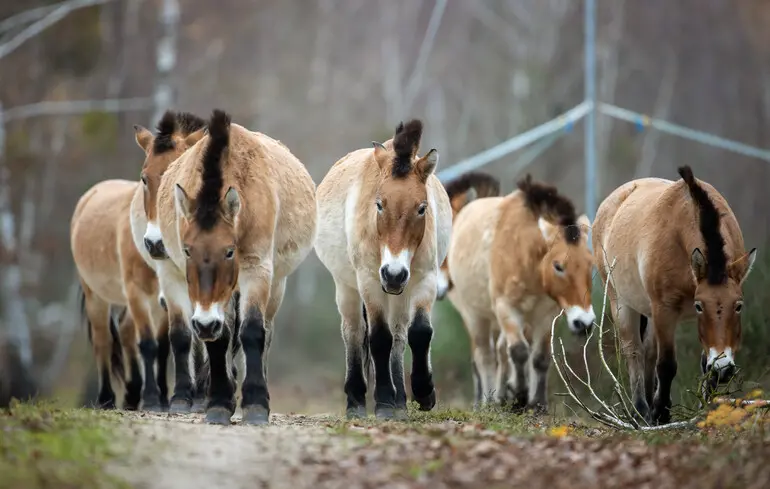
A herd of Przewalski’s horses (Equus ferus przewalskii)—the only wild horse to have survived to the present day. The species, once declared extinct in the wild, was restored from literally a few dozen individuals.
In the late 1990s, several horses were released into the Chornobyl Exclusion Zone. Against all predictions, the animals took hold, turned feral and multiplied.
Since then, the herd has grown roughly sevenfold. The horses have even ventured into the Red Forest—the most contaminated part of the zone. The population here became one of the largest free-ranging populations of the species (worldwide there are now about 3,000 of them in all).
On the very first day of the full-scale invasion, Russian forces seized the Chornobyl Zone and held it for about five weeks. By some estimates, around 22,000 hectares burned, and several Przewalski’s horses were blown up by mines—the most recent such death was recorded in the summer of 2025. Years of monitoring the animals came to a halt.
And yet, in the spring of 2026, the horses were still grazing on radioactive meadows larger than Luxembourg. The reserve’s lead scientist, Denys Vyshnevskyi, called the existence of this free population “a small miracle.”
Ecocide
Ukraine accounts for less than 6 percent of Europe’s area, yet thanks to its importance for migratory species and its geographic diversity, it holds 35 percent of Europe’s biodiversity—more than 70,000 species, many of them rare, relict or endemic.
According to an estimate by the Ukrainian Nature Conservation Group, in 2022, 44 percent of the nature reserve fund’s area ended up in a combat zone or under occupation. Almost 15 percent of these territories fell within scorched-earth zones.
Under threat are 2.9 million hectares of the Emerald Network—the system of protected areas that European countries are building under the Bern Convention (Ukraine has roughly 377 such sites). Environmental damage was estimated at more than €52 billion in just the first 16 months of the full-scale war.
Scientists call the destruction of the Kakhovka Dam on June 6, 2023, the greatest ecological disaster of the war. Then some 30,000 cubic meters of water per second surged through the breach, against the usual 2,600.
The reservoir—2,155 square kilometers in area and roughly 18 cubic kilometers in volume—had dried up completely by the end of June. The losses of just two southern national parks—Velykyi Luh and Kamianska Sich—were put at more than 15 and 73 billion hryvnias respectively. Dozens of rare habitat types protected under the Bern Convention ended up in the disaster zone.
Researchers are recording not only destruction but also a partial recovery of ecosystems downstream: on the bed of the former reservoir, willows, poplars and typical steppe grasses have already sprouted.
Theft, and a Rewriting of History
Nearby lies Askania-Nova, under occupation since 2022. The reserve is effectively teetering on the edge of existence: some of its animals were taken to Crimea and Russia, many of them died from neglect, and large tracts of virgin steppe burned. On the seized territory, there were also reports of “safaris”—in effect, the shooting of the reserve’s protected animals.
Russia does not merely kill the animals—it steals them and then claims them as its own. After occupying the reserve in 2022, the Russians installed their own pseudo-administration here, headed by “director” Dmitriy Meshcheryakov, and put the looting on an industrial footing.
According to the Prosecutor General’s Office, Meshcheryakov, together with representatives of Russian nature reserves, organized the illegal removal of rare and vanishing animal species. Among them were Chapman’s zebras, American bison, the world’s rarest Père David’s deer (milu), and Przewalski’s horse, which is listed in Ukraine’s Red Book.
Some animals were moved separately to the Crimean lion park Taigan. Prosecutors classified this as a war crime—plunder in violation of the Geneva and Hague Conventions—and assessed the damage at 85.2 million hryvnias. In April 2026, the “director” was sentenced in absentia to 15 years in prison—the first verdict in Ukraine’s history for a war crime against the nature reserve fund.
At the same time, Russian state media are rewriting the very history of the species’ rescue. ZN.UA has established that in July 2024 the official Rossiyskaya Gazeta was already presenting captured Askania as “its own” reserve, one that “needs help,” and cited its own “tally”—claiming that 56 Przewalski’s horses live there, descendants of the “legendary four mares,” each one “worth its weight in gold.”
Even earlier, in 2022, the State Duma’s Parlamentskaya Gazeta laid the ideological groundwork for the future “transfers”: supposedly “Przewalski’s horse is above politics,” its conservation “requires exchanges and the consolidation of data into the international studbook,” and the first center for the species’ recovery was “established in ‘our’ country—at Askania-Nova.”
The international studbook for Przewalski’s horse—the species’ principal global register—is maintained by Prague Zoo, and it is there that information on every individual is recorded. Whether the stolen Askania horses have appeared in this register under a Russian holder is not yet known: we found no confirmation of it, and only the studbook’s curators have access to its current individual records.
Still in the Plural, for Now
Some have been lost for good—the saiga left the Ukrainian steppe back in the 19th century, following the tarpan, and the Black Sea monk seal has disappeared from our waters altogether.
Among the mammals under threat in Ukraine today are the European mink, the relict Russian desman, the marbled polecat, the speckled ground squirrel, and a number of bat species (among them the horseshoe bats), as well as the European bison, whose population in Ukraine has to be rebuilt.
Among birds, the steppe giants are critically vulnerable—the great bustard [Photo 10] and the little bustard—as are the rare raptors the saker falcon, the greater spotted eagle, the steppe eagle, and the white-tailed eagle; and, on migration and wintering grounds, the sociable lapwing, the red-breasted goose, and the white-headed duck. Among rare breeding birds is the azure tit.
The great bustard (Otis tarda)—the heaviest flying bird in Europe and a symbol of the Ukrainian steppe, teetering on the brink of extinction in Ukraine. Video: Getty Images.
In rivers and inland waters, facing extinction, are the Black Sea and Azov sturgeons: the beluga, the starry sturgeon, the Russian sturgeon, and the sterlet, fished out and cut off by a cascade of dams almost to the point of disappearance. The population of the European eel is fading too, its numbers having collapsed across Europe.
Marine biologist Ivan Rusev of the Tuzly Estuaries National Park has, since the first weeks of the full-scale war, kept a chronicle of the dolphins that have died. The military sonar of Russian ships and submarines destroys the acoustic system of cetaceans: robbed of its “hearing,” a dolphin loses the ability to orient itself and dies.
By an extrapolated estimate from Ukrainian and Polish scientists, published in the journal Biology Letters, in just the first three months of the invasion, between 37,500 and 48,000 cetaceans died in the Black Sea.
The steppe itself is quietly vanishing too: feather grass, the pasque flower, Schrenck’s tulip and dozens of endemic plants and insects—from narrow-range Crimean species to the stag beetle.
Each of them is a potential endling.
A Snail in a Shattered Shell
The historian of science Lydia Pyne calls endlings the “fables of the Anthropocene”—characters in the stories humanity tells itself about its own losses. But an endling is not just a single death. The disappearance of a keystone species can bring down an entire ecosystem, and so behind every “last one” we happened to notice stand hundreds of nameless creatures that never got a “Martha” or a “George” of their own.
This leitmotif runs through the debut novel Endling by the Ukrainian-Canadian writer Mariia Reva. The book drew critical attention and made the 2025 Booker Prize longlist.
The novel’s protagonist, a mollusk specialist named Yeva, has turned an old camper van into a mobile laboratory and travels around Ukraine in search of rare snails. Many of her finds are already endlings, the last of their kind, with no mate to be found. To fund her expeditions, Yeva works for an agency running a peculiar brand of marriage tourism for foreigners, all the while nursing a secret plan to expose the industry.
The full-scale invasion turns the text into metafiction. In the novel, refugees hide in ruined houses, “like snails in shattered shells.” The vanishing of the snail and the vanishing of people rhyme by design: the heroine stubbornly breeds her doomed mollusks, and in doing so mounts a hopeless resistance to death.
Mariia Reva was born in Kherson and lived there until she was seven—not far from the place where the last tarpan was killed. Her summers were spent at a dacha near the mouth of the Dnipro. After the destruction of the Kakhovka Dam, this area went completely underwater.
The writer’s grandfather refused to leave occupied Kherson and survived by a miracle when a Russian shell exploded in his yard. He lived, but the world he had known is gone—like that very snail with its shattered shell.
In the end, it is not only a biological species that becomes an endling, but also a home destroyed by war. It matters to hold on stubbornly to memory, for as long as there is someone to testify to what has been lost, there remains a difference between vanishing and being forgotten.