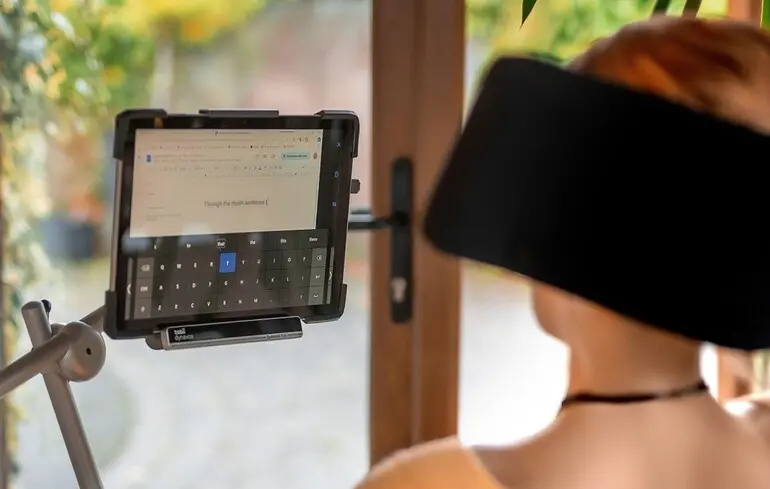
If you take away a person’s ability to speak, to move, to control their body, locking them inside themselves, is that already death? Ukrainian writer, TV presenter and actress Maryna Borodina, struck by amyotrophic lateral sclerosis (ALS), proves that it is not. A personality is not so easily destroyed as long as the brain still functions, even if only a very narrow channel remains open to the world. Life goes on, even if in another form.
Maryna now communicates with the world through eye movements that control a computer cursor. She has written a book about herself with her eyes, entitled Against the Wind. The book has all the makings of a bestseller. On the eve of its presentation in Kyiv, we spoke with the author.
VK: Maryna, how, what and when did it happen?
MB: It all began when I dropped the gun from my left hand. No, not metaphorically—literally. On set in Los Angeles six years ago. I was playing a spy in latex, and suddenly the prop slipped from my hand—and with it, everything I had built for 33 years. It turned out to be not a mistake but a prologue. I was diagnosed with ALS. Hollywood closed its doors, and another one opened—into the depths. No freeze-frame. No director. Just life—without retakes.
VK: What were the first symptoms?
MB: Even before the gun episode, I felt weakness in the fingers of my left hand, but I was sure it was from intensive boxing training and would soon pass. Three months later, I suddenly began stumbling when standing on my left leg. American doctors could not explain what was happening. I consulted everyone. The only advice was, “Come back for another examination in three months.” Instead, I went to Ukraine. At the Multiple Sclerosis Center, they figure everything out right away.
Then it became harder to pronounce words clearly. My tongue grew heavy, as if I were drunk. Then I began falling. Two months later my neck weakened and could no longer hold my head when I leaned back. Within a year, I couldn’t even hold a plastic spoon, swallowing became difficult, I began choking on food, and I moved into a wheelchair. Every two or three months, I lost another function. My mind was chasing my body like a dog running after a train. It couldn’t keep up. It was fast. It was hell. But now I am a firewalker.
VK: What do you think causes the disease?
MB: No one knows. Science shrugs its shoulders, doctors sigh in helplessness. I improvise. My genes are fine. Perhaps my soul asked too much of this life. It was given ALS—an evolutionary elevator. No buttons. No handrails. Its only upward from here.
VK: What was your life like before it happened?
MB: I was like a turbine, constantly in motion. I was born in a mining village in the Donetsk region. At 17, while still in school, I started working as a TV presenter. Then the KRT TV channel moved to Kyiv, and I moved with it. In Kyiv, I studied acting and began starring in films. Later I married and returned to my home region.
We lived happily in Donetsk: a spacious apartment near parks, friends, work, a family business, parents close by. I raised my sons, helped my parents and worked as host of major events. Then, in 2014, the war changed everything. We moved to Kyiv with my parents, thinking it would be temporary. But “temporary” became permanent. There, I returned to my dream, cinema.
I studied at theater studios, the Ukrainian Film School, acted in films. I took a course in Florence, then received a grant to study in Los Angeles. It was a hard decision—to see my children only once every three months for a year, to give up serious projects in Kyiv. But I chose education. In the US, I had to start from scratch, but it was an incredible experience: the New York Film Academy, work on Universal Studios sets, teachers from Hollywood, new friends, and the world of cinema from the inside. I spent a year and a half there, received a diploma and a US work permit, signed a contract with an acting agent, and began acting in films. My dreams seemed to be coming true. But it was there, on set, that my left hand first failed to hold the gun… and my life began to move in an entirely different direction.
VK: When did you realize that mobility would never return?
MB: From the look in my loved ones’ eyes. I will never forget it. When I say something—as I think I did a week ago—and they don’t understand a word. And they nod, so as not to upset me, pretending they do. But eyes don’t lie.
VK: How long did it take you to decide to keep living?
MB: Three months. That was exactly the time I had left before my scheduled euthanasia. I thought I would be a burden to my family. But my sons’ eyes and laughter, the philosophy of Stoicism, the principles of yoga and new technologies convinced me to stay. I became myself again—just in a new form.
VK: How did you communicate before you had the eye sensor?
MB: I created a special alphabet that we still use. I can pronounce certain sounds, and their sequence tells my loved ones what I mean. A stranger would never understand it. I also used facial expressions and gestures: blinking meant “yes,” shaking my head side to side meant “no,” and so on.
VK: When did you get the sensor? How does it work?
MB: In fall 2020. It cost about €3,000. Friends ordered and brought it to me. It’s called an eye-tracker—a thin strip beneath the monitor that tracks eye movement. I use Tobii Dynavox Eye Gaze: infrared sensors under the screen shine into the eyes, a camera captures reflections on the cornea and pupil, and an algorithm turns that into a cursor and a “click.”
VK: Was it hard to learn to use it?
MB: It was a test of mental endurance. At first, I couldn’t even open the virtual keyboard.
VK: What was the first word you wrote with your eyes? What did you feel?
MB: It wasn’t a word, it was a shot. With my eyes. Into silence. Probably “hello.” I felt the taste of freedom.
VK: What is it like to be constantly inside yourself? What if you want to get out, to throw a plate on the floor?
MB: It’s like sitting in a glass ball: you see everything but can’t intervene. Sometimes you want to stand up, to say something to bang your fist on the table. But you can’t even wink. Writing is the only remaining thing. Writing with your eyes. Throwing sentences. They fly truer than plates.
VK: What is your book about? What was the process of writing like?
MB: My book Against the Wind is not about illness. It’s about challenge, love and the search for meaning. I wrote it with my eyes over 16 months, working six to eight hours a day. Usually with coffee by my side—not to drink but simply to inhale its aroma. The hardest part was honesty. Irony came effortlessly. It saved me. Like a bulletproof vest made of laughter.
VK: What is your daily routine?
MB: I wake up, do breathing exercises, meditate. Then I get down to work: writing the book (the English version is now in the final stages of editing), letters to teachers and doctors, online orders, physical therapy, spending time outdoors. And some rest. The day is strictly structured; otherwise the body cannot cope.
VK: Tell us about your children.
MB: I have two teenage sons. And they are incredible. They grew up alongside my illness. They became responsible and caring. They don’t just help; they accept. They are not afraid of my silence. I write them letters. I tell them important things. We are learning to live together in a new format. And they have a great sense of humor. Sometimes I think it is what holds our home together.
VK: The traditional question: what are your future plans?
MB: To get my voice back—through Neuralink. To adapt Against the Wind for the screen. I’m working on it. And to watch my children grow up. That is the most important thing.
VK: And if Wi-Fi disappears, and you cannot communicate with your eyes?
MB: Oh, then I’ll become a philosopher. I’ll look out the window and think about the meaning of life. Or I’ll try to turn on the router with the power of my gaze. If that fails, I’ll have to write a book about life without Wi-Fi. It will be a thriller.
VK: Where do you live now?
MB: In Ireland. With my family. It’s calmer here, and a little easier to arrange care. But my heart is always in Ukraine.
VK: Who helps you live and create?
MB: My team is my family, friends, project partners and those simply beside me. I feel their support. Without it, nothing would be possible. My friends still come to visit me, even though the trip takes them a whole day because I live in the countryside. And then there are rituals: breathing practices, meditation, music to keep rhythm and books to keep me from burning out.
VK: A delicate question: about the father of your children…
MB: My husband is not with me, but we have a good relationship.
For reference (ZN.UA)
Amyotrophic lateral sclerosis (ALS) is a progressive, incurable, degenerative disease of the central nervous system that affects both upper (motor cortex of the brain) and lower (anterior horns of the spinal cord and cranial nerve nuclei) motor neurons. It leads to paralysis (paresis) of the limbs and subsequent muscle atrophy. Stephen Hawking, a famous British theoretical physicist, cosmologist and writer, suffered from this disease. The vast majority of cases (90–95 percent) are not hereditary and cannot be explained by external factors (past illnesses, injuries, environmental conditions, etc.).