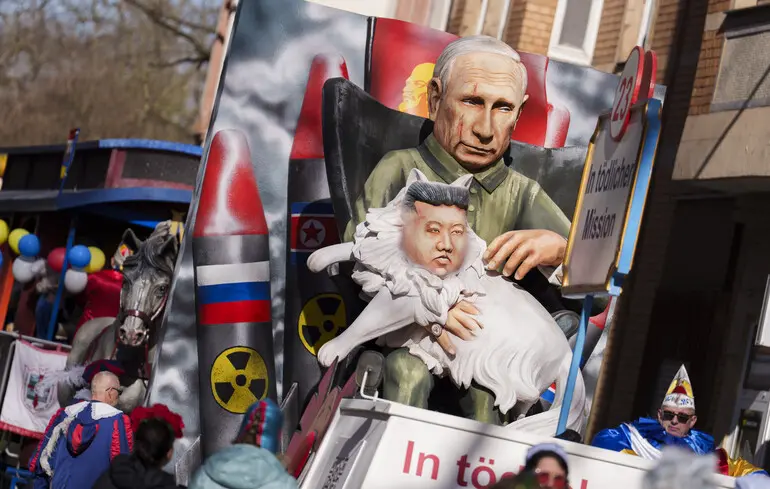
Russia’s war against Ukraine is increasingly assuming the characteristics of not merely a bilateral conflict but a fully-fledged international armed confrontation. Several states have moved beyond political or economic alignment to active participation, including the use of national territory, provision of military infrastructure, and logistical support essential to Russia’s war effort. Notable examples include the Democratic People’s Republic of Korea (DPRK) and Belarus.
Before turning to legal definitions, one crucial distinction must be made: the regimes in question can’t be equated with the international support Ukraine receives. Ukraine is defending itself against armed aggression in line with Article 51 of the UN Charter, corresponding right of collective and self-defense. Ukraine’s partners act within the bounds of international law by assisting the victim of aggression. Those who aid the aggressor, by contrast, are complicit in an international crime.
UN General Assembly Resolution 3314 (1974) clearly defines what constitutes an act of aggression. This includes “the invasion or attack by the armed forces of a State of the territory of another State,” or even “any military occupation, however temporary.” What matters isn’t rhetoric or official statements, but action, namely, using armed force.
For a long time, the involvement of DPRK forces remained in the realm of speculation and alarming signals. Now, however, such information has been confirmed officially. North Korean prisoners of war have testified to the presence of DPRK troops fighting against Ukraine’s Defense Forces in the Kursk Region. Russia’s President Vladimir Putin has acknowledged their role, thanking Pyongyang for its support. There is reason to believe this concerns more than a few isolated troops but an organized form of military assistance, at minimum, functioning units operating alongside Russian forces.
The same UNGA resolution says that aggression also includes “the sending by or on behalf of a State of armed bands, groups, irregulars or mercenaries,” when their actions amount to the use of armed force. This is precisely what we are witnessing. The deployment of North Korean troops to the combat zone, with the knowledge and support of the DPRK government, constitutes a direct violation of international law. It’s mere political backing. It’s aggression.
Belarus’s role is no less clear. Article 3(f) of Resolution 3314 defines aggression as “allowing its territory, which it has placed at the disposal of another State, to be used by that other State for perpetrating an act of aggression against a third State.” Belarus’s conduct falls squarely within this provision, providing Russia with everything needed: infrastructure, logistics, airfield access, and corridors for missiles and aircraft. While Belarusian troops haven’t formally entered Ukrainian territory, the country's involvement in the war is undeniable.
UNGA Resolution ES‑11/1 of March 2, 2022, condemned Belarus's involvement. However, it did so in diplomatic language, avoiding the term “co-aggressor.” This legal vacuum must be addressed, and Ukraine should lead the way.
The situation is further complicated by the 2023 Russian-DPRK strategic partnership treaty, which called for mutual defense, economic and other cooperation. Although formally a bilateral agreement, it is de facto evidence of political and military coordination between the two regimes. Under Article 103 of the UN Charter, no such treaty can override a state’s international obligations. This is evidence, not justification.
The International Court of Justice’s reasoning in Nicaragua v. United States is instructive. The Court concluded that material support to armed groups may constitute an unlawful use of force, even absent direct troop deployment. Although U.S. troops didn’t formally invade Nicaragua, their support of the Contras violated the principle of non-intervention and, due to its scale, amounted to an unlawful use of force. The Court also emphasised that the location of the violence is irrelevant; external interference constitutes a breach of the UN Charter. The parallels to our current situation are evident, even if North Korean troops are deployed solely on Russian soil.
Ukraine must act decisively. Parliament should officially declare the DPRK a state that has committed an act of aggression, and designate Belarus as a co-aggressor. The draft legislation addressing Belarus’s role has long been pending. It’s time to take the next step and proceed with the DPRK’s direct involvement.
The subsequent phase must be international: diplomatic engagement and introduction of the matter before the UNGA. When Russia’s veto paralyzes the Security Council, the General Assembly becomes the arena for defending justice, as it has in the past. This path is viable.
Finally, North Korea’s involvement in Russia’s war means that any future special international tribunal for the crime of aggression (should it be established) must broaden its scope of defendants. It can’t be limited to representatives of the Russian and Belarusian military-political leadership. DPRK officials involved in the political, diplomatic, or military decisions in support of aggression must also stand trial. The tribunal must serve as a landmark of historical accountability, affirming to all who’d ally with an aggressor: violations of the international legal order and international crimes won’t go unanswered.