How stable is Ukraine’s economy in the face of immense pressure from Russia, which has launched a war of destruction against us? Many are asking this question. It is particularly relevant ahead of the upcoming fourth international conference on Ukraine’s recovery—URC2025. What is the status quo? What tasks lie ahead? And what are the optimal scenarios for the country’s recovery after a devastating war?
These and other questions were addressed by leading economic experts at the forum Ukraine’s Economy on the Eve of URC2025 and the New Budget Cycle.
So, is Ukraine’s economy stable today?
Oleksandra Betliy, leading research fellow at the Institute for Economic Research and Policy Consulting, broke her answer down into several components.
The first block is the government.
Since the beginning of the full-scale invasion, it has remained functional and continues to be effective. For example, when Ukraine applied for EU membership in the early days of the war, many were initially shocked at what turned out to be the right move.
The second block is business.
It has adapted to wartime conditions, figured out how to respond to challenges and what to do. Business continues to function and create new production facilities.
The third block is people.
Five million people have left the country—a significant loss, especially considering that these are primarily working-age adults and children. Yet, by various estimates, 32 million people remain in Ukraine. They work, consume and pay taxes. Some are defending Ukraine on the frontline. And this is also part of the broader picture of resilience. It is crucial to develop a housing stock for the 4.6 million internally displaced persons. This would help bring back our people who went abroad because their homes were destroyed. It is equally important for those who remain in the temporarily occupied territories: if we provide them with housing and job opportunities here, some of them may move to government-controlled areas—and these are our Ukrainians, for whom we must fight.
The fourth block is international partners. They are with us, and today, half of Ukraine’s state budget is financed through international assistance. We also receive military aid from international partners.
Security factors, of course, remain of paramount importance, and this is what has to be taken into consideration. The progress of the war and the intensity of fighting have an overarching influence on every area of our lives.
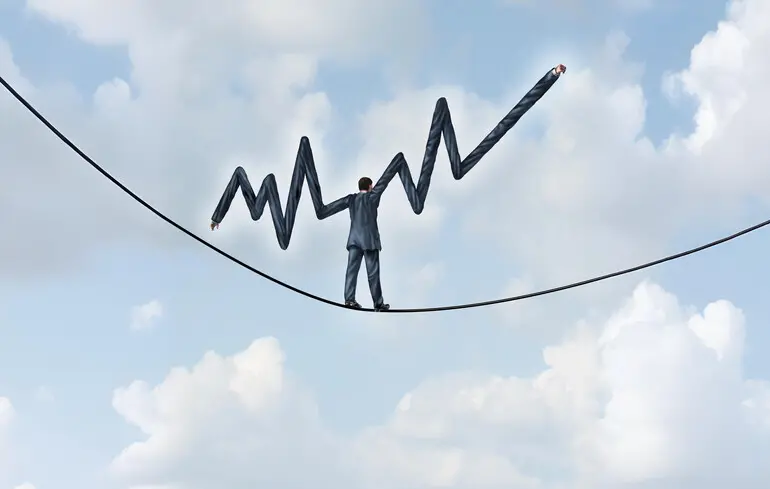
If any one of these four elements falters, we risk losing stability. Are there threats? Absolutely: this stability is built on rather fragile foundations. For instance, there is uncertainty surrounding the position of the current US administration (sometimes support is there, sometimes not) and persistent disagreements within the EU regarding Ukraine. The level of uncertainty remains high. This uncertainty concerns not only the intensity of combat operations but also the reliability of international support. The stability and predictability of such support is especially critical.
Numerically, our fragile stability looks as follows. According to the Institute for Economic Research, real GDP in the first quarter grew by 0.7 percent year-on-year — slightly below forecast. However, it remains over 20 percent lower than pre-war levels (for more detailed figures, see this source).
The 2025 budget was based on the assumption that the intensity of hostilities would decrease in the second half of the year. Unfortunately, that has not happened, so amendments to the State Budget Law are forthcoming. Defense and security expenditures will be increased by UAH 400 billion. These expenses will be covered by taxes paid by businesses and households, which is why honest tax compliance is critically important.
Our government has taken on numerous obligations, and much of the international aid Ukraine receives is tied to the “money for reforms” principle. European integration is not a smooth journey. We must invest in new rules and procedures at the business level. But it is crucial to understand: these reforms—for which we receive funding—are necessary for Ukraine itself, to ensure a stable economy and build a foundation for future growth. At the same time, the IMF program serves as a benchmark for other partners. If we fail to meet structural beacons under the IMF program and it stalls, other partners will become increasingly cautious and may even reconsider further assistance.
Given our challenging wartime circumstances, the IMF has postponed certain structural beacons. Nevertheless, it is difficult to explain, for example, why we failed to conduct a timely competition for the head of the Economic Security Bureau, or why the audit of the National Anti-Corruption Bureau was delayed multiple times. Each unfulfilled beacon represents forgone aid that the Ministry of Finance had factored into its budget planning. While funding for 2025 may be generally sufficient, it certainly will not be enough for 2026; therefore, Ukraine must meet its obligations promptly, and the government and parliament must work hand in hand.
For instance, the parliament made considerable efforts to adopt Draft Law No. 8222 on civil service in a timely manner. Yet it took the president two and a half months to sign it, even though this is a key indicator under the Ukraine Facility plan.
Reconstruction is being financed by international organizations, particularly the World Bank and the European Investment Bank. These funds are provided in the form of concessional long-term loans. However, they will have to be repaid. That requires economic growth, reforms and robust state institutions. This includes civil service reform, better public financial management and the creation of a high-quality business environment.
Defense capabilities, once again, depend on domestic revenue. Ukrainian businesses must take on their socially important responsibility: to pay taxes honestly, rather than evading them through various schemes. It is time for businesses to rally around a common goal: to say no to bribes and demand reforms of law enforcement, customs, taxation and the judiciary. There should be no division of businesses into “white,” “gray” and “black” sectors.
A noteworthy comment came from Oksana Kuziakiv, head of the Center for Contemporary Society Studies at the Institute for Economic Research and Policy Consulting. She highlighted some worrying signals.
According to Kuziakiv, “stability” and “fragility” are antonyms. You cannot build something stable on a fragile foundation—it will simply collapse. Therefore, what we have is far from fragile; otherwise, we wouldn’t be experiencing this kind of stability.
We see this stability with our own eyes—in the streets, in our wallets and in shops. Based on monthly surveys of business directors, the main trend is optimism rooted in the experience of adaptation.
One example is the restoration of lost logistical connections between suppliers and consumers. This was one of the most acute problems businesses faced at the start of the full-scale invasion. Today, only 8 percent of respondents cite this as an issue—meaning businesses have shown flexibility and responded to the challenge. Another example is business operations during blackouts. This was a problem—but one that businesses adapted to relatively quickly.
The positive shift over these three years has been a transition from shock to normalization. Uncertainty has decreased, and its structure has changed. As a result, we now have relatively optimistic expectations in May 2025. Two-thirds of businesses are operating at nearly the same level of production capacity utilization as before the war.
However, warning signs that growth may plateau are increasingly evident. A number of indicators point in that direction. This suggests that, to move forward, Ukraine must break out of the vicious circle of external constraints.
What do businesses need? Security. Predictability. People. These are the three elements that must be guaranteed. Labor shortage, physical insecurity, inflation fears and daily-life difficulties remain the main challenges facing Ukrainian business during the war.
But in the long term, labor scarcity is poised to become the most critical challenge.
“Together with our businesses, we may reach a limit of capabilities beyond which we cannot go. Business sustainability must be supported—because everything has its limit,” emphasized Oksana Kuziakiv.
Note to readers: URC2025 is the fourth international conference on Ukraine’s recovery, continuing a series of high-level political events devoted to the rapid recovery and long-term reconstruction of Ukraine since the start of Russia’s full-scale war. The conference will take place on July 10–11, 2025.