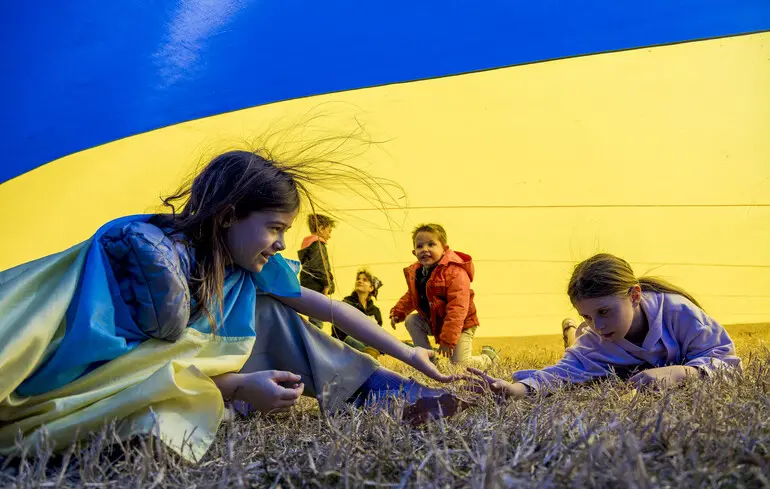
Today, across Ukraine, all schools across the country celebrate the traditional holiday, Last Bell. It is an occasion that each of us, regardless of age, holds special memories of — whether from our own childhood or from parenthood, when we proudly watch our children complete another school year. Some return to this celebration year after year with their students.
This year, for the third time, the holiday takes place under the shadow of a full-scale war. Not all schools can afford to hold the Last Bell ceremony in the way it has traditionally been conducted — in a wide circle in a spacious schoolyard. With the ceremonial entrance of excited graduates, standing for the final time with their classmates and teachers on their school grounds. On the very playground where, years earlier, today’s graduates once arrived as young children — adorned with bows, carrying oversized bouquets and wearing brand-new school backpacks.
But not every school will be able to hold such a celebration today. In cities under fire, like Kherson, the Last Bell will ring in bomb shelters, to the background of sirens and shelling. Yet this will not make it any less heartfelt or meaningful. Perhaps, on the contrary, it will make it even more moving and heartfelt. Possibly even special, sending shivers down the spine, a reality vividly reflected in Kherson.
On the eve of the holiday, ZN.UA spoke with Natalia Zhurzhenko, head of the Kherson City Council’s education department, about how the academic year unfolded and what this day will look like for the children of the city.
OO: Natalia, how was this school year? Not in terms of reporting, but emotionally.
NZ: If we look at it from the standpoint of reporting, then I could say that our school year proceeded just like in any other city or region. The same lessons, competitions and celebrations. But when you start thinking about the conditions in which all of this took place, you realize that there was absolutely nothing ordinary about it. To understand how the school year went, one must understand the conditions people in Kherson are living under.
Kherson is a city of shattered windows and collapsed roofs. It is being shelled so heavily that there is likely not a single intact window left. We have 151 educational institutions, and 138 of them have been damaged. Of those, nine have been razed to the ground. And under these harrowing conditions, teachers still continued to teach.
When I say that the city is under constant shelling, I’m not exaggerating. Our entire life unfolds under bombardment. Whether we’re heading to work, conducting a lesson or simply going to the store, there are constant explosions all around. People start getting anxious when it’s quiet for even 15–20 minutes, wondering why it’s quiet and what might be coming next. That’s how both our days and nights go by. And in recent months, drones have tormented us endlessly. They’re everywhere, like flies. At the beginning of the school year, there were still some areas in the city they didn’t reach. Now, there are no relatively safe places left.
This week alone, four kindergartens were damaged by drones. Two of them are in areas we previously thought were out of range. One drone simply dropped explosives on a kindergarten and flew off. At another site, an empty drone crashed into the yard (it had dropped its explosives elsewhere). People came to work and found it lying there in the courtyard. But there’s no label on a drone saying whether it’s armed or not. That’s why a typical workday for our school and kindergarten staff begins with inspecting the premises—to determine whether it’s safe to move around the territory.
Because the drones drop not only explosives but also “petal” mines—small mines that only detonate when stepped on. So it’s not just within the school or kindergarten—you never know, even just walking through the city, whether to keep your eyes on the ground or on the sky.
Every resident of Kherson understands that, to the enemy, they are a military target. Even a grandmother walking to the store for bread is considered a military target. Russian forces drop explosives from drones on anything that moves—whether it's an ambulance, public utilities or public transport. Our minibuses (marshrutkas) are frequently hit by explosives dropped from drones. And in those minibuses, people are just trying to get to work.
OO: Are there many children in Kherson now?
NZ: For the last two years, about 5,000 children permanently reside in the city, and we have 21,000 in total. Education in Kherson is remote. During the war, we lost a lot of children: before the war, there were 34,000 of them, that number has now dwindled to 21,000. Of those, half are abroad. So, you know, the stories about the order of the Ministry of Education No. 1112, according to which children have to sit at school in the region where they are physically located, are very painful for us. On the one hand, we understand that children need to study, develop and communicate with their peers. On the other hand, if our Kherson students are forced to go to schools in the cities where they are currently living with their parents, our teachers will be left without work. Because 5,000 children do not need 21,000 teachers.
Teachers who have left for safer regions will probably find work there. But what about those who stay in Kherson? We have almost 1,500 teachers, about 60 percent of them live in the city. They simply won't be able to find a job here, even in another profession. Layoffs will be a disaster for them. If we lose teachers now, who will restore education after the victory?
OO: Is it difficult to organize remote learning under fire? There must be connection and electricity issues.
NZ: When it comes to electricity issues, it's thanks to the tireless work and determination of our utility crews that we've been able to handle them. You asked about teachers, but now I want to talk about the utility workers as well. They repair all damaged power lines so quickly that within half an hour after a power outage, the power comes back on. These people work in extremely difficult conditions, they never take off their bulletproof vests because they go to the shelled areas of the city. They deserve our deepest gratitude for their courage.
In December, we faced a particularly trying moment when a critical infrastructure facility supplying electricity to the entire city was struck by shelling. Many residents feared the power might never be restored. Yet once again, our utility workers worked a miracle — though it took them several grueling days. But the way we got through those dark days speaks volumes about the resilience and dedication of our teachers.
In our city, there are invincibility centers, mostly located in schools. I see that the country has an ambiguous attitude to them: some say they are needed there, others say they are not, some are outraged that such points have been opened in educational institutions. But for us, for the people of Kherson, this is a completely different story. Out of 23 invincibility centers in the city, 17 are located in educational institutions, and for our teachers, it is an opportunity to communicate with children in person, not just online. Because parents come there to charge their phones, receive humanitarian aid and often take their children with them. This allows teachers to organize various activities.
So back in December, when the city faced an extended blackout, I went to check on our invincibility centers (equipped with generators and Starlinks, where we could at least count on power and mobile phone service). At one school, I witnessed a scene that truly stopped me in my tracks. Several teachers had come to the center, put their desks in the corridor to be closer to the Starlink for a stronger connection, put on their headphones, opened their laptops — and were giving lessons. I said to them, “The situation with electricity is critical—you could take a break, just for today.” They looked at me and said, “Why would we stop? We have eight classes scheduled. There’s no time to stop.”
They understand that it was an emergency in Kherson, but the children who are in other regions and study in our schools remotely have no problems with electricity and are waiting for their lessons.
OO: Can you recall moments when teachers themselves needed support more than they could provide it?
NZ: You know, there are many such stories, and I don't have enough time to mention them all. I often travel to educational institutions, observe my colleagues, and they also come to our office. My colleagues smile, but I see how psychologically exhausted they are. There are psychologists in our educational institutions, but no one taught them at universities how to provide assistance in wartime. However, having already had their own experience of living under occupation, living under fire, they are constantly learning on their own, finding different courses and helping children and adults. We also try to get our teachers to participate in mental health trainings for educators, and we cooperate with NGOs. Still, all this stress has such an impact even on people's physical health that this week our primary school teacher passed away. Her heart stopped. She taught lessons during the day, and then she felt sick, and the ambulance could not save her. Her pre-retirement age and constant stress took their toll.
Once, during one of the trainings, we asked teachers about what they would like. They said: “Take us to another city for a few days.” This matters. I need to take my colleagues somewhere. I need to take them out so that they remember what normal life is. They are so used to explosions and sirens that they often do not react to them, do not go down to the shelters. I see that their survival instinct is beginning to fade. But you need to react to the alarm, and you need to be constantly on your toes to save your life. It is important to remember that living amid explosions is not normal. That's why our teachers need to visit some safer regions and communicate with their colleagues.
We contacted an NGO that organizes psychological off-site trainings. We also had help from our colleagues from other cities: we keep in touch with departments and educational institutions in other regions, and if they are ready to host us, we gather, go there and communicate. No one has ever refused us any help, advice or live communication. Educators across Ukraine are united, and it is very important for all of us to have the support of our colleagues. We share experiences, visit educational institutions and, of course, have a cultural program—theaters, exhibitions, museums.
I would like to speak about Kyiv with a special sense of warmth. This is truly the heart of our country, and we are very touched by the way the educators of the capital always help us. When the Russians blew up the Kakhovka hydroelectric power plant, our Kyiv colleagues repeatedly sent humanitarian aid to our teachers: clothes, hygiene kits, food and everything else they needed. When during the occupation of Kherson we were restoring centralized accounting, discontinued by traitors and occupiers who tried to leave Kherson teachers without salaries, the director of the Department of Education, Olena Fidanian, helped us a lot. “Tell us what you need, and we will do everything,” she said. This is the shoulder to lean on in a difficult moment.
In general, I never cease to be amazed by my fellow teachers from Kherson. Despite each of them carrying their own painful stories of war—some having lost loved ones, others their homes, and many caring for the wounded—they still find the strength to respond compassionately to the suffering of others. One of these stories happened this year and struck me, probably twice. The first time was when the Russians hit a high-rise building with an aerial bomb and destroyed the entire entrance. A family was affected, a mother and two children: the mother died, but the children survived. And, of course, the whole city helped the kids. Their father was abroad, he had gone there a few years before the war, and he needed time to return to Ukraine and take these children. Physically, they sustained only minor injuries and were discharged from the hospital shortly after. The townspeople gathered the necessary things for them, and the school donated gadgets for their studies. But where should they go after hospital? And then one of the school principals called me and said: “Natalia, if you have nowhere else to put the children, I am ready to take them to my place.” And this was the second moment in that story that struck me. Because during this war, this headmaster first lost her son, and then her husband was killed in the Donetsk area. Her house is uninhabitable because it is located in a dangerous place near the river, which is constantly shelled. She does not even have the opportunity to go and see if it still stands. The woman lives alone, renting an apartment, but she is ready to take these two children. And they are not her students or even from her school. It was simply, you know, a deeply human and emotional impulse to support children who, given their tender age, may not yet fully comprehend the magnitude of the tragedy they had endured. And she herself, having a teacher's salary, without housing, without the opportunity to live normally, is ready to give everything to help these children.
OO: Natalia, what was the most challenging aspect for you personally, as the person entrusted with overseeing the entire education system of Kherson, during this school year?
NZ: The hardest thing is to endure emotions. When your colleagues come and share their experiences and situations, and you realize that you feel the same way and have the same fears, but you can't show it. Because you need to support them. They look at me, and, you know, I'm like a litmus test for them: if I lose my inner fortitude, they will lose it too. We support each other in this way. If I get upset, they get tense and think that everything is bad, it’s all over. So I find the strength to say words of support to my colleagues, to calm them down and give them the strength to work. I tell them that everything will be fine, everything will be Ukraine.
It pains me to look at our kids in kindergartens because in Kherson they work online. I don't know how to explain this even to educators from other regions who are surprised: the children are still very young, how can you teach them remotely? It is not only the skill of our teachers, their mastery of all kinds of programs, applications and gadgets, but also a lot of work with parents who join the classes with their children. It’s really very difficult because parents have to master all these distance learning technologies as well. And now cooperation is so well established that our kindergartens hold not only classes online but also holiday matinees and puppet theaters. We also write fairy tales.
It is painful to look at the children who live in Kherson now. During air raid sirens (and we have them all the time), the city goes underground, and any live meeting with teachers is possible only in the basement. You know, you can call the simplest shelter a lot of fancy words, but, in fact, it is a basement. It’s beautiful, painted, equipped, but it’s still a basement. And when the children gather for a celebration in that basement, their joy and overwhelming emotions upon seeing each other—so deprived of face-to-face communication—are heartrending to witness.
I was very impressed with the reaction of the kids to the guests during the Christmas holidays. We invited two soldiers from our Kherson brigade to come and greet the children. The kids were playing in the shelter at that moment, and when the soldiers suddenly came in, the children just hugged them and circled around the room. They were so emotional! The soldiers were even confused: they didn't know what to do, they didn't expect so many children to rush to hug them. And then, when these five-year-olds sang Chervona Kalyna [Red Viburnum, a Ukrainian patriotic march] for them, you had to see the eyes of these guys to guess what was going on inside their souls. Afterward, a little girl came up to one of the soldiers, hugged him and said: “Do you know that I am Ukrainian?” I still tell this story and tears well up in my eyes. We have many such emotional moments.
This year it was painful to watch my fellow teachers. A few weeks ago, we visited Cherkasy with an educational delegation. This city has become a twin city of Kherson under the Side by Side: Cohesive Communities project. Local educators invited us to visit them, and we went to a school that is exactly the same as ours in Kherson. I look and see children holding hands and running to the canteen. And I just had tears in my eyes because in Kherson schools we haven't seen children running around carefree during recess for three years. Our schools have been quiet for three years now, and we have forgotten the lively bustle of noisy corridors. I looked at my colleagues and realized that they all had tears in their eyes and thought the same thing.
At first, we were worried when the occupiers broke windows or damaged the roof of the school. But now we realize that this is not what is scary. It is scarier when you enter the building and it is really quiet. And flowers are blooming. There are a lot of flowers, and my colleagues take care of them. The energy that permeates the walls of schools and kindergartens probably also supports these flowers. Sometimes you come to an institution because it has suffered from shelling, you need to see the damage, decide how to repair it, what to cover the windows with... You turn your head and there is a note on the blackboard: “February 23, classwork.” And teachers have not erased this date since the beginning of the full-scale invasion.
In Kherson, one grandmother asked her grandson, “How many children do you have in your class?” “I don't know,” he said. “I have four squares on the screen at the top and four at the bottom.” Because the child looks at the screen during the lesson and sees only the eight children that the screen can accommodate. And when our children say phrases like that, it’s scary. That’s why I say that the hardest thing is to endure emotions.
OO: Will there be the Last Bell holiday in Kherson? How will it be held?
NZ: For several years now, we have been organizing both the First Bell and the Last Bell celebrations online for most children. But for those children who are in Kherson, we try to organize celebrations offline as well.
This academic year, we began just as before—taking shelter in basements. But we had a real celebration where the children picked up the bell and opened the school year. Grandparents, mothers with small children—so many people came! And here, on the one hand, you are glad that they have at least a small holiday, but on the other hand, your heart skips a beat because during the holiday you hear explosions all the time. Thank God, everything went well. We will decide whether we can hold the Last Bell holiday offline this year depending on the security situation. Over the past three weeks, the drones have been relentless, and no one will put the children at risk.
Regarding our 11th-grade graduates, for the third consecutive year, we have managed to hold an in-person ceremony to present certificates of completion. This year, we have around 1,500 graduates. While it’s impossible to invite everyone, we traditionally gather those students who graduate with honors at the Osvitoria Hub in Kyiv. This year, we plan to do the same. We invite celebrities, award children and give them gifts. Even those children who are abroad come to attend this holiday.
In the first year when we came up with this idea, we were not sure that our graduates from all over the world would come just to get a certificate of education. But we were wrong when we thought they were coming for the document. They are coming to see their classmates for the last time, with whom they may be separated for life because they will go to different countries. Many children come to such graduation meetings, often with their parents.
I am very pleased that during the years of the full-scale war, Kherson has taken the second place among all regional centers in terms of the average National Multi-subject Test score. This is the second year in a row that we have had this result, although we did not have that before the war. This is a testament to the strength of the children’s spirit. It also shows how well our teachers have organized remote learning.
I feel very sorry for those children who are now in the occupied territory (there are about 600 of them among our students). The diligence with which they connect to classes is unlike anything others do. For them, our remote lessons are, on the one hand, a danger to their lives because the occupiers are against everything Ukrainian, especially education. On the other hand, they cling to the Ukrainian school, to their educational institution, so much that they still take risks. The headmaster of a Kherson school forwarded me messages from parents saying that they probably wouldn't be able to join the lessons anymore because Russians came to their homes, saw that their child was joining classes at a Ukrainian school and threatened even to take the child away from the family if he or she didn't go to a Russian school. Of course, the parents fear for the child’s life. And it’s scary to imagine what these people are going through. But it’s even scarier when a mother describes how her child cried because she couldn’t pass a written paper and join the class. Because studying at a native Ukrainian school is a connection for her child with her homeland, her hometown, her home, her friends. And this connection was simply trampled by the enemy. I don't know how one can survive this. And how to bring this child back and heal his psychological trauma.
Last week, I was visited by a father and a girl who had left the occupied territory in the Henichesk district just a month ago. They came confused because at the beginning of the full-scale invasion, the child was finishing the ninth grade, but because of the occupation, she was no longer able to obtain a document from the Ukrainian school about it. Now she has to finish the eleventh grade, but for two years the Russians forced her to go to a Russian school. And now the child has no Ukrainian certificate of education for either the ninth or eleventh grade. She and her father asked me for advice on what to do. I explained that first they needed to get a document for the ninth grade, and then for the tenth and eleventh grades. I put them in touch with the headmaster and explained that they could study under the extramural program. The girl said, “No, I want to study in high school full time because I dream of going to university and I realize how much knowledge I have lost in these two years. I want to finish school properly first.” What our children are enduring now is a burden no child should ever have to bear.
OO: Natalia, what inspires you and gives you strength?
NZ: Communication with children and colleagues. For example, when you come to a resilience center in a kindergarten and see a group of parents working with a psychologist, drawing something, making bracelets. I ask them, “What are doing?” And the psychologist explains that the children stayed at home with their grandmothers, and their parents came and said, "We aren’t going to miss the classes for parents!” They just sit there and talk.
It also gives you strength when you go out into the yard of the kindergarten and see that lettuce, garlic and parsley are planted there. I ask the teachers, “Ladies, what is this?” They answered that they had found some kind of competition for kindergartens called Plant A Garden. “So we decided to take part,” they said. And such courage and thirst for life is truly inspiring.
It gives you strength when you go to the music room in another kindergarten and all the teachers have gathered there to record a video lesson for the children. And you realize that no drones or explosions will break these people. They know exactly what they are doing, and they definitely go to work not for a salary, but because it is their calling. I look at them and realize that nothing is impossible for educators. In times of war, in addition to teaching classes, they have already learned how to pour oil into generators, how to turn off all the switches in a dangerous situation, how to screw an OSB board to a plastic window frame from which the glass has fallen out.
Teachers should not know and be able to do this, but they do because sometimes there is no one else to do it. For example, there are situations when our utility workers do not have time to come right away because the city suffers a lot of damage, and the day is coming to an end and you cannot leave a school or kindergarten overnight with broken windows. When you see such courage of people, it is inspiring.
OO: And the last question: you don't have to answer it if you don't want to. If you had the opportunity to say something to the whole country on behalf of the teachers of Kherson about your pain, about your resilience or perhaps about some request, if you have one, what would you say?
NZ: Let me think... I would probably say this. Our country is big, diverse and beautiful. Believe in it. I have a request not only to educators but to all Ukrainians in general: do not give up. And remember that there are our Armed Forces of Ukraine who protect us, and it is much harder for them than for us. No matter what difficulties we are experiencing in the rear, no matter what troubles we are facing, it is harder for them. If they do not put down their weapons, we have no right to give up either. We have to support each other and them.