Power corrupts. Absolute power corrupts absolutely. The example of Viktor Yanukovych, hurriedly hauling his accumulated possessions out of his "Khonka" residence, scared no one. Because he got them out. Because nobody was punished—which means it can be done again.
Now, for the first time in independent Ukraine, a precedent is being set for the interim accountability of those in power for the results of their rule: not yet a verdict, but already a reckoning. Bankova's appetite turned out to be so great that constant overeating brought the country's number-two man to the point where he was left utterly alone. In front of dozens of lenses and cameras, broadcasting across the country his stately helplessness and the rage and grievance boiling inside him, with nowhere to go.
But even public disgrace does not compare with a cell in pre-trial detention paid for by your lawyer. Within those walls, Andrii Yermak was, in all likelihood, made to understand how the house he had built—in both the literal and the figurative sense—with graveyard sand was collapsing. Sand which, according to investigators, was illegally brought to Kozyn, a wealthy enclave south of Kyiv, from a working cemetery in the town of Ukrainka.
Presidential friendship was dear to Yermak, as long as it brought him power, but it became too dear for the president himself when it began to require accountability. To go first and put up part of the bail for Yermak, setting an example for the rest, would have meant publicly admitting: Yermak is still one of us. Not to pay personally was to ditch Yermak as a toxic asset.
Volodymyr Zelenskyy chose the second option. For the public and for his inner circle, he did not put up any of the bail himself. Behind the scenes, he stamped his feet and barked orders to find the money.
On Monday all the money was on the bank account. After four nights in pre-trial detention, Yermak walked out. With his own conclusions.
And we walk out of this story—an instructive one as far as those in power are concerned—with ours.
First: Yermak was absolutely sure there would be no notice of suspicion
According to our sources, after the notice of suspicion was served, the former head of the Presidential Office Andrii Yermak and his lawyer Ihor Fomin did not sleep for three days. It was not just a matter of working through the 16 volumes of the case file. In parallel, they had to raise 180 million hryvnia for the bail demanded by the SAPO prosecutor.
It was clear the sum would not be small. In the end, the judge shaved it down to 140 million. Yermak and his lawyer had had a whole six months (!) to prepare a bail in clean money. And no one had lifted so much as a finger. There was no strategy and no plan. Why?
Because Yermak was absolutely sure: there would be no notice of suspicion at all.
Was he sure of it because he considered himself untouchable and, as we once wrote, had "bought a crown in Sanahunt and wears it" (Sanahunt being the high-end designer boutique where Kyiv's wealthy do their shopping)? Was he counting on the expert examinations of the Dynasty housing cooperative properties being dragged out or derailed altogether? On pressure on the experts and on the key players of the anti-corruption system—the heads of NABU and SAPO—producing the required outcome? Did he reckon that the constant drip-feed of leaks into pro-government Telegram channels and the Security Service’s tireless work with the witness Khrystenko against the head of SAPO Klymenko would settle the matter in his favor? Or did he assume that there existed an agreement between the president and NABU, with a particular term of validity, and that it would not be broken?
One way or another, Andrii Yermak felt safe. And what happened on the day the notice of suspicion was served came as a shock to him.
Second: the president did not put up bail
After the notice of suspicion against Yermak, Zelenskyy offered the public no explanation: he did not defend him, did not distance himself directly, did not take responsibility for the man who had for years been his principal instrument of governance. The body of which Yermak was a part shed him as a lizard sheds its tail, without uttering a sound. The system was reading the cues.
The doors of the Anti-Corruption Court proved too heavy for any of those who might have come to support Andrii Yermak. No friends, no subordinates grateful for their posts, none from yesterday's inner circle. As his lawyer made clear, Yermak himself did not want family members in the room. In front of dozens of cameras, the once all-powerful head of the Presidential Office sat alone. And that was only the first act. The second was the bail.
Of course, Zelenskyy was able to arrange a private cell in pre-trial detention for his friend. Tatarov did his bit. Plainly, Yermak had a phone and his own guard at the door. According to our sources, even the demeaning inscription next to Yermak's surname—the name of a bird that, in post-Soviet prison slang, designates the lowest caste of inmates and makes life in the prison hierarchy decidedly harder (left there by Oleksandr Dubinskyi, a former Servant of the People MP now facing high treason charges, before his transfer to the Mensk correctional colony in zones one and five of the exercise yard)—was painted over straight away. That is a lot for a boss. Not much for a friend.
Zelenskyy busied himself with the bail: he put everyone on edge, demanded that the money be found, parcelled out the tasks. That is, he did everything except the main thing—he did not put up bail himself. He did not set the example. Did not risk his own money. Did not want to dirty his hands by helping his friend.
It is not a matter of covering the lot—according to the declarations he had filed, Zelenskyy could have found a few million. As a boss who, by his own words, sacked the former head of his office not for corruption. As a man who had repeatedly called Yermak a friend and stressed that "He came in with me, and he will leave with me." As a politician who for years had cultivated within the system the image of a stand-up guy who keeps his word and stands by his inner circle.
But he did not find it. More precisely—he did not want to. And the system read the signal again.
After "number one" had not put up bail, there is hardly any point asking where the rest of the president’s coterie was. Where were all those equally well-heeled people? Where was Serhii Shefir, who could easily have done it in his wife's name—the wife to whom, according to media reports, his money and assets had been transferred after the publication of the tapes?
Where was David Arakhamia, currently the purse-keeper in this country? There is hardly a kiosk left in Ukraine that does not recognize its owner. Even if the head of the Servant of the People faction took offence at finding his surname on the list of Yermak's enemies kept by a specialist in astrology and feng shui.
Where were the "great builders" Kyrylo Tymoshenko and Yurii Holyk, the men who ran Zelenskyy's Big Construction infrastructure program?? Where was Maksym Shkil, a road building tycoon, who hints with all his might that road construction is being shut down across the board, and that he himself "has nothing to eat because of those people building the Dynasty cooperative? Where was Maksym Krippa—an oligarchic-scale figure who has risen up under this government from almost nothing?
And again, the famous line of Ihor Kolomoiskyi comes to mind: "Life is a supermarket: take what you want, but remember—the cash register is at the exit." Only in this case the register turned out to be empty as well. Why? Because they know how to skilfully siphon billions out—through offshores, crypto assets and "dynasties." But not how to bring them in. They know how to add and multiply what is theirs. But not to subtract, not to lose, not to share.
If they do lose anything or anyone in this story, it will be only Yermak himself. All those who have received notices of suspicion—Chernyshov, Mindich, Shurma et cetera—can turn Yermak in. Yermak himself can only turn in "R1"… (R1: a mansion in the Dynasty complex, which according to media reports was earmarked for someone referred to in the materials of the Midas case only as “Vova”—a diminutive of Volodymyr.)
Third: the black system could not quickly find white money
In fact, the Anti-Corruption Court arranged near-preferential conditions for Yermak: in high-profile cases the preventive measure is usually decided on a Friday so that the suspect, as it were, gets a swift taste of justice and stays in pre-trial detention through Saturday and Sunday. Here the judge handed down the decision on Thursday morning. The defense had two business days to gather and pay into the Anti-Corruption Court's special deposit account 140 million hryvnia. In clean money.
The money was scraped together from every corner. The tasks were parcelled out to Tatarov, Kuleba, Arakhamia, Kiper and even Budanov. The president demanded that others find the money while standing aside himself.
As the lawyer Fomin stated, the full sum had been gathered by Friday evening. But the money did not all make it onto the Anti-Corruption Court's account in time. And here, they say, a part was played by the head of the State Financial Monitoring Service, Filip Pronin—one of Yermak's permanent protégés. More precisely, Pronin went off on yet another business trip, and his deputy signed an order that the origin of the transferred sums be checked thoroughly.
This is not about the payers who have already been named publicly, but about how the system tried to gather the remainder. According to our sources, in the search for white money for the bail, those in power went so far as to set up their own exchange rate: three to one. For every legal hryvnia that could be paid into the Anti-Corruption Court's account, they were promising three hryvnias of compensation from where the money in this system is usually kept.
But the main conclusion is by now obvious: the black system was unable, even for itself, to produce white money quickly. People who were disposing of hundreds of billions from the budget, international assistance and back offices were unable to gather 140 million legal hryvnias in good time for a man whom only yesterday they had regarded as the country's number two. This was not a banking-day glitch—it was a failure of the system. It showed that what held it together was not loyalty, nor a common purse, but fear. A living corruption machine is recognized not by the fact that it ultimately found the money, but by the speed with which it rescues its own. There was no speed here.
Fourth: the inner circle decided they had already settled up
Yermak had placed hundreds of people in cushy jobs. Jobs from which they would leave much richer than when they came in. But not one of them was in a hurry to transfer anything to him. That is the degree of his toxicity.
Businesses did not want to do it: they were afraid of giving investigative journalists material to work with and letting them work out precisely where and exactly who owed money to Yermak.
The plan, as the Presidential Office saw it, was for fellow members of the legal guild to cover the entire bail. But many lawyers refused, fearing reputational damage. Although for some of them, according to our information, the banks did not let the money through—certain documents were missing. For others, the money was credited but then refused because it was dirty.
Systems built on subordination and humiliation sooner or later bury their builders. The humiliated and insulted do not turn up at court hearings and do not pay for those who held them for years on a short leash. They paid off their debt long ago: in money, in favors, in breaches of the law, in shady schemes—in anything you like. Their own dignity included.
No one feels indebted to Yermak any more.
Fifth: the story was pushed forward by NABU, the media and society
Only Soviet-era throwbacks of the Mykola "Yanych" Azarov variety—Yanukovych's exiled prime minister, now broadcasting from Russia—the toadies of anonymous Telegram channels and Kremlin voices can be peddling the line that the anti-corruption bodies received orders from the United States. It is plain to everyone that Trump has lost interest in Ukraine and in the toolkit America had built up there. NABU and SAPO received no orders from the FBI. They were being driven on by society.
For the first time in our memory—without USAID, without instructions from Washington or Brussels—civil society demanded an investigation and made sure it was being carried out. We did not hear from the opposition. Not from Petro Poroshenko, not from Yuliia Tymoshenko, not from Serhii Prytula, not from the poll-leading Valerii Zaluzhnyi. From no one who might have been representing a different political position.
There was only NABU, the media, society and the crime, which laid bare not only the essence of the government but its organizational helplessness.
Yermak's defense is building its line on accusing society and the media of putting pressure on NABU and SAPO. Fomin spoke about it in court, and so did Yermak himself in his comments. But people want justice. They heard on the tapes—which have already gone into the materials being considered by the court—that there is a "R2," an "Andrii," an "AB" (Andrii Borysovych – Yermak’s first name and patronymic) in there, and they wanted to see accountability.
Politics, of course, has run ahead of the legal process. The investigation is continuing, and only the court will determine the degree of responsibility of Yermak, Mindich, Chernyshov and the rest of the case's many figures. NABU, as we have said before, still has the larger part of the "Mindich recordings" on its hands, whose contents we can only guess at. And NABU is not only investigating the actions of the figures we already know about, but is gathering materials, as it were, in reserve.
The whole country has already seen one thing: there are no untouchables. Gentlemen, you can be touched now. Even if for the moment pre-trial detention has, for four nights, embraced only one of the pillars of your system. The system no longer guarantees anyone's safety. Not Umerov's, not Shefir's, not anyone else's who only yesterday saw it as their personal armor. They are sitting now, watching all of this, and thinking: who is going to put up bail for me, and how, if it ended like this for the country's number two?
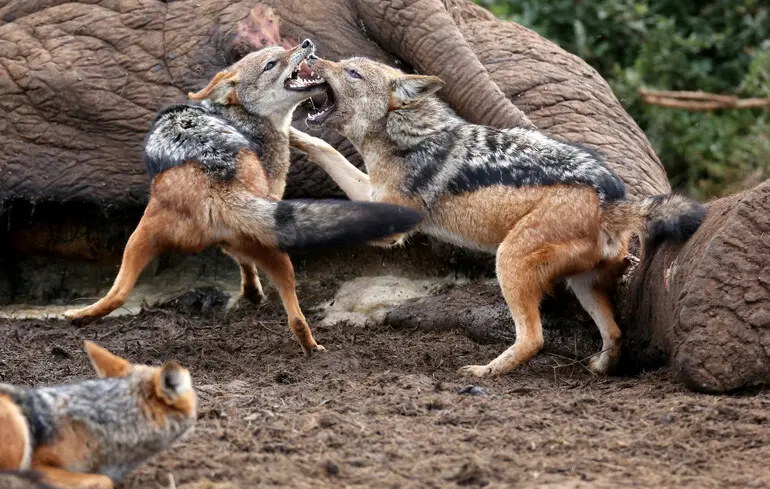
That, in essence, is the answer. Four men building their houses on eight hectares of land is not a matter of taste, but of mentality. They have not, even now, left behind the dormitory in which neither a team nor even a pack was ever born. At least a pack stands by its own. Here it was not wolves but jackals: first to slink away from the wounded, never late to the feast.