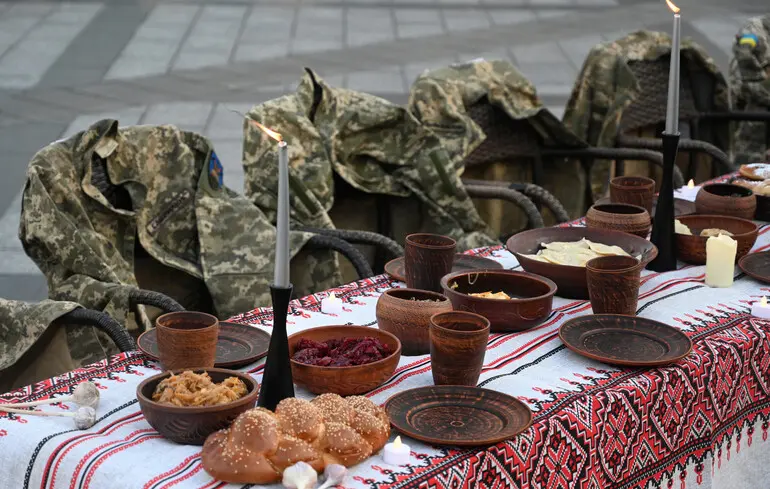
Every missing person has a family waiting for them—parents, partners, children, siblings. Psychologists refer to this state as ambiguous loss—grief without the chance to say goodbye, where the psyche becomes suspended between “what was” and “what might be.” Ukraine already has tens of thousands of such stories, each its own front line, where the only weapons are faith and resilience.
As of May 2025, the Ukrainian registry lists over 70,000 missing military personnel and civilians. Yet the number of those enduring unresolved emotional pain is about four times greater.
To avoid breaking under the pressure, women seek personal coping strategies: some piece together fragments of information in online chats, others channel their pain into creativity or volunteer work. But the power of self-help cannot replace the need for continuous support: without professional guidance and a safe environment, even the strongest reach their limits.
At the conference RETURN. The Path to Mental Recovery, women whose husbands or sons are missing in action shared their personal stories. Their testimonies served as a raw and painful reminder of war’s invisible front—the front of waiting, uncertainty and daily psychological trial. In open dialogue with experts and fellow participants, they stressed the critical need for professional support, for not being left alone with their grief and for a space where they can speak and be heard.
The conference took place as part of the national RETURN project, founded by Viktor and Olena Pinchuk. The initiative seeks to establish a nationwide network of mental health centers for service members, veterans and their families. At least 25 such centers are planned across Ukraine in the initial phase, with the first already operating in the frontline city of Dnipro.
Anastasiia Ihnatiuk, psychologist and coordinator of the Ukrainian-Swiss project Mental Health for Ukraine: “The Ukrainian-Swiss project Mental Health for Ukraine spans several areas of activity, including efforts to mitigate the effects of war. In partnership with others, we launched the initiative Living in Waiting.
The name came from the participants themselves—relatives of the missing: mothers, wives, daughters, sisters—because they have been in this limbo since receiving the initial news. Living in Waiting is not just a series of interventions but a full-fledged support model for families experiencing ambiguous loss.
In therapy sessions, wives often ask: ‘Who am I now? Am I still a wife or already a widow? How can I choose a role in life when I don’t even know my husband’s fate?’ These existential questions reflect a profound identity crisis and must be addressed therapeutically.
The goal is to foster resilience and the capacity to endure uncertainty, because the grieving process cannot be completed in the absence of external clarity.”
Ruslana Bronovytska, writer, mother of a missing soldier and assistant to the Living in Waiting community: “I am the mother of a missing soldier, a volunteer. For over a year and a half, I have had no word of him.
I come from the cultural and artistic world—I’m a cultural manager, journalist and director. I never imagined I would become a writer. But after my son disappeared, all my pain poured into poetry as a form of reflection.
A friend of mine, a psychologist and writer, read my poems and said they had great artistic value—deep metaphors and powerful imagery that reach the soul and can help other women like me.
The artist who illustrated the book told me: ‘You have no idea how many women can find your line “I pull myself out from under the wheels” helpful.’
People call us unbreakable, but I break down every day, every minute. I didn’t even know what ambiguous loss was at first. I didn’t understand what was happening. I experienced shock, total denial and self-blame.
I couldn’t handle the formal aspects of the search, opening a criminal case, etc. I lacked the emotional strength. I’m grateful to my ex-husband, the father of my son, and his girlfriend’s mother—they took care of everything. I just lay in bed, stared at the ceiling and cried every night.
I remember the moment I wanted to open the window and jump. But thank God, common sense kicked in.
My thirteen-year-old daughter told me: ‘Mom, it wouldn’t be fair if you died. Dima [missing son’s name] will come back, and you won’t be there. You will have betrayed him.’ That was like a cold shower. Whether I liked it or not, I had to keep living.
At first, I didn’t even consider seeing a psychologist. I was convinced I could handle it. But when my blood pressure started spiking, I reached out to an old friend who’s a doctor. I told him everything. He said, ‘You need antidepressants.’ I refused, but I went to see him anyway. Eventually, he and the psychologist persuaded me to change my mind. If I had had the mindset I have now, I would have gone to therapy much earlier.
My social circle changed dramatically after I received the notification. First, the news was so deeply personal that I didn’t want to share it. Second, when people asked things like, ‘Are you doing anything? Have you talked to his comrades? Are you even looking for him?’—it broke me. Yes, I cry. But we are searching. Now, if I see someone who asked me those questions, I cross the street to avoid ever speaking to them again.”
Ivanna Lukavetska, assistant to Living in Waiting and wife of a missing soldier: “I am the wife of a missing soldier. I have been searching and waiting for a year and seven months. I still know nothing about his whereabouts.
One day, I was in the kitchen when someone from the military enlistment office knocked on my door. They handed me a notice. I couldn’t comprehend it—my husband was supposed to be home in two days, on leave. Everything went blurry. I didn’t know what to do. I wandered from room to room, looked around. I picked up his belongings, breathed in his scent. I have two children, and when I looked at them, I saw fear in their eyes. They, too, didn’t know what was going on—because they were waiting for their father to come home.
I knew I had to hold it together, but I couldn’t sleep at night. It was a hellish month. Ambiguous loss is a kind of unknown—he was, and now he’s gone. Things became much easier when I was invited to a Living in Waiting community meeting.
The old folk wisdom echoed in my head: ‘Why go to a psychologist? They’ll just mess with your mind.’ But within the community, I began seeing a psychologist. It helped immensely—I learned to manage my emotions.
My social circle changed drastically. People I used to talk to no longer understand me. Now, those who’ve suffered the same grief are my family. Because with them, I feel safe. We share a common language, and no one judges or criticizes us.”
Viktoriia Naumovych, psychologist accompanying a support group for relatives of the missing in Rivne region: “I’m from a small town in the Rivne region and work as a psychologist with the Living in Waiting project. When I first read our mission—‘to reduce suffering and strengthen the resilience of family members of missing soldiers’—it sounded overly ambitious. I doubted whether I was the right person to ease someone’s suffering. But in my work, I see how women change—and how they change one another’s lives.
When we talk about ambiguous loss as a phenomenon, we must recognize that it is the most difficult form of loss. There is no closure, no finality. The psyche cannot adapt. This uncertainty leads to a breakdown of identity, self-isolation and avoidance of even close relationships. People experience ambivalence: hope on one side, mourning on the other. Constantly oscillating between these poles leads to rapid emotional exhaustion.
People living with ambiguous loss often describe it as existing between suffering and the need to carry on with daily life. They feel the ground slipping from beneath their feet, as if they’ve lost all control. We do not work through grief and loss in the conventional sense. We work to help people learn how to live with ambivalence and uncertainty.”